Within the high-stakes realm of contemporary serious oversteer competition, success is no longer solely a function of raw engine power or pilot courage. Rather, it has evolved into a intricate discipline which requires a painstaking marriage of choosing a inherently capable chassis, outfitting it with the correct drift-spec parts, and, most essentially, grasping its real-time performance on the circuit through sophisticated suspension tuning applications. This comprehensive handbook acts as your roadmap from the very first idea of a competition vehicle right through to the final data-informed adjustments that transform a strong vehicle into a repeatable podium finisher. We will thoroughly explore the art and science of car suspension tuning, demonstrating how a advanced drift tuning app like precise measurement hardware removes approximation and offers exceptional clarity into your chassis's real-world dynamics.
The bedrock of any successful drift car is, undoubtedly, the platform itself. Certain platforms have attained legendary reputation within the global drifting scene due to their built-in weight distribution, durable design, and the vast ecosystem of performance support available. Choosing the optimal starting point is the primary and most significant choice a enthusiast will make. To illustrate, the the E36 generation BMW is commonly accepted as perhaps the the greatest balanced cars for drifting of the modern era. Its excellent evenly distributed mass, combined with a RWD configuration and bulletproof six-cylinder engines, establishes a platform that is simultaneously accessible for beginners and incredibly competitive in the hands of a professional competitor. The successor of this lineage, the BMW E46 platform, refines these attributes with a increasingly sophisticated frame, wider stance for enhanced high-speed stability, and still a greater degree of turning capability straight from the OEM. A different formidable option in the top-level arena is the Corvette C6.
This V8-powered sports car brings a unique array of strengths to the sideways sport, such as a lightweight alloy frame, a rear-mounted drivetrain component that aids in an excellent front-to-rear mass ratio, and the colossal torque of a powerful LS V8 motor. This blend makes it an complete monster on track, capable of starting and holding continuous drifts with seemingly easy application of power. For builders seeking exceptional value, the 350Z model Nissan excels as a prime choice. It arrives from the manufacturer with a robust body structure, a competent factory LSD, and the free-revving VQ series engine that offers ample power and torque for learning and advancing in the sport. Its successor, the Nissan 370Z, brings more improvements in body strength, suspension design, and overall motor power, solidifying its position as a favorite pick among professional drivers. Other iconic vehicles that warrant attention are the lightweight rotary-powered Mazda FC, the most popular Nissan S13, the torque-rich SN95 generation Mustang, the electronic-equipped E90 3 Series, and the tiny yet unbelievably engaging and teachable Mazda MX-5. Every single one of these cars provides a different array of traits, challenges, and possibilities, but they all share the core ingredients essential to be transformed into a competitive drift machine.
However, selecting the right chassis is merely the first step. To access the complete performance of any of these vehicles, major upgrades to the steering system and damping and springing systems are completely mandatory. This is where the world of performance aftermarket components becomes sharp importance. The one most impactful modification for a serious competition vehicle is the integration of a drift-spec drift angle kit. These sophisticated systems, for example those manufactured by specialist companies like SLR Speed, are created to dramatically enhance the car's possible steering angle. A standard street car is severely constrained in how far its tires can rotate, a engineering trade-off for on-road use. In oversteer driving, conversely, aggressive opposite lock is continuously needed to manage and hold a angle. An steering kit replaces the factory uprights, rod ends, and often A-arms with parts that enable the front tires to attain angles over 70 or even 80 degrees, compared to a typical OEM angle of around 40 to 50 degs.
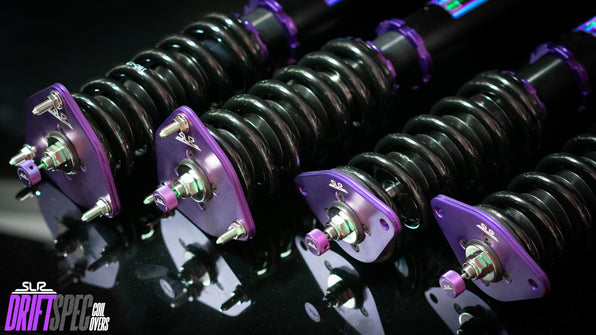
This vastly expanded steering angle provides the pilot with significantly enhanced control during a drift, enabling it to be much simpler to start a oversteer moment, hold it through a extended corner, and switch smoothly from one side to another. The difference in controllability is nothing short of transformative. Combined with a properly chosen angle kit is the just as vital enhancement to the chassis's damping system. Off-the-shelf or even premium sport coilovers are generally not designed for the unique and brutal demands of sliding. A dedicated pair of suspension units is crucial. These specific suspension components feature custom piston tuning and spring stiffness that are optimized for the extreme load shifting that is typical of sliding. When a driver starts a angle, the car's mass is transferred violently to the outer of the bend. Correct performance dampers handle this transfer in a controllable manner, enabling the chassis to stabilize quickly and providing the operator clear response through the wheel and seat. They furthermore enable precise setting of ground clearance, damping rate, and cross-weight, which are all integral elements of dialing in the chassis's behavior to a specific venue or driving approach. In combination, a high-quality angle modification system and a correctly chosen system of performance adjustable dampers form the core mechanical cornerstone upon which all later optimization is built.
Once the essential parts is in place, the next vital stage in the project is the meticulous setting of the car's alignment. This is the realm of chassis dynamics adjustment, a procedure that can seem daunting to the beginner but is, in fact, the key to turning a assembly of capable components into a cohesive and controllable vehicle. The most discussed parameter of suspension geometry for oversteer is definitely negative camber. Wheel camber is the tilt of the wheel compared to the perfectly straight line when viewed from the front of the chassis. If the upper part of the wheel is tilted inward, this is called inward tilt. In sliding, negative camber on the steering tires is generally used and is regarded as essential. The purpose is fundamentally tied to tire contact.
When a car is turning at extreme slip angles, the frame rolls towards the external of the corner. This body roll makes the outer front tire to reduce its best contact patch with the asphalt. By introducing negative camber, the wheel is pre-leaned to compensate for this lean. As the chassis tilts into the bend, the tire becomes more upright on the track, increasing its traction at the critical moment when it is needed most for control. Typically, front camber settings for a dedicated drift car range from approximately -3 degrees to as high as -5 degrees or even beyond, contingent on the parameters of the vehicle geometry, rubber selection, and pilot preference. The rear tires also employ inward lean, but the values are generally less and more nuanced than the front axle. Too much camber at the back can make the car overly loose and challenging to manage on throttle use, as it diminishes the available grip area of the driven tires during linear throttle application. Hence, rear axle adjustments are commonly in the vicinity of -1 degree to -3 degrees, achieving a precise equilibrium between giving adequate lateral traction to aid in initiating and maintaining the slide while simultaneously preserving effective grip for acceleration the bend. Camber is just one part of the broader tuning puzzle, which also includes toe angle, caster angle, and suspension-induced steering modification.
Toe setting refers to the angle of the wheels when viewed from the top. Positive toe means the leading edges of the tires are nearer together than the rear edges, while outward toe means the reverse. For oversteer, a small amount of front negative toe is often employed to improve the initial response steering reaction, making the chassis feel more agile and willing to begin a oversteer moment. Rear toe setting is generally set to neutral or a very small amount of inward toe to foster stability under acceleration. caster angle is the longitudinal or aft tilt of the kingpin axis when looked at from the lateral of the chassis. Positive caster improves feedback and high-velocity solidity, and it additionally adds to negative camber increase during steering, which is highly useful. Adjusting these settings is a detailed interplay where a adjustment to a single setting can and will influence the others. The old-school process for dialing in a vehicle's suspension geometry for competition has long been a time-consuming endeavor of trial and error. A pilot or engineering group would make a adjustment based on intuition, test the car on track, use the driver's personal feel and comments, and then make a further adjustment. This loop would repeat again and again until the chassis felt "right" or the scheduled track period ran out. This system is not only extremely wasteful in terms of hours and costs, but it is also inherently flawed.
Human sensation is a notoriously inconsistent data source, affected by countless elements such as tiredness, changing track grip levels, ambient heat, and simply the focus of the driver on that given session. What feels "loose" on one run might feel "tight" on the subsequent run, car suspension tuning causing conflicting feedback and counterproductive adjustments. This traditional problem in chassis setup is exactly where state-of-the-art engineering tools has stepped in to completely change the landscape.
The advent and integration of specialized suspension tuning applications has brought about a completely new era for tuning and refining competitive drift cars. This new generation of tools, exemplified by cutting-edge solutions like GripDial, work by physically capturing the real-time dynamic behavior of the chassis as it is operated on the track. As opposed to relying on personal impression, these systems gather objective data on key factors such as suspension travel, wheel speed, acceleration forces, lock position, and driver input position. This collected data stream is then processed by sophisticated applications that can graph and interpret the metrics in a actionable way. For the first time, drivers and builders can observe exactly what the chassis is performing at every point of a slide. This capability revolutionizes the whole alignment optimization procedure. Think about the particular task of optimizing the front camber for a particular car. Instead of making a change from -3 degrees to -3.5 degrees and then running many passes to try and "sense" a difference, a suspension tuning tool can provide immediate and definitive information. The application can display graphically how the tire's loading is acting during the most important stages of a drift: initiation, holding the angle, and switch. It can show if the current value is suspension tuning tool permitting the steering tire to maintain ideal grip or if the tire is overloaded on its external edge.
The system can after analysis provide data-driven advice for change. Perhaps the data reveals that the tire is even stressing its outer shoulder at -3.5 degrees of negative camber, indicating that even more inward lean, say -4 degrees, might be beneficial. Alternatively, the data might reveal that the tire is failing to reaching temperature or that the inner edge is wearing unevenly, which could indicate that there is overly aggressive inward lean and a modest reduction back to -3.2 degrees would be more ideal. This standard of accuracy and practical insight was completely unimaginable in the days of exclusively manual adjustment.
The impact of using a dedicated suspension tuning tool reaches far beyond just setting camber. It serves as an essential coilover setup tips that is customized to your particular chassis. When adjusting the rebound and compression clickers on your coilovers, instead of depending on imprecise guidelines or replicating another team's setup, you can use the telemetry to see how the chassis is reacting in relation to your changes. The tool can graph the wheel movement data over a section of track, revealing if the coilovers are controlling the weight transfer effectively or if they are permitting the vehicle to become unsettled too much after a direction change. It can aid in pinpointing problems like excessive compression or topping out, enabling you to make informed choices to preload settings, damping settings, or ground clearance. This approach extends similarly to the complex task of suspension geometry optimization. In addition to camber, the system can provide insight into how adjustments to toe and caster are affecting the chassis's balance during various maneuvers of a drift. For example, it can help you to find the best amount of front toe-out for your particular steering setup and competition technique by analyzing the speed of turn-in reaction and the predictability of the car at full countersteer. This turns the system an exceptionally useful drift suspension tuning guide that is constantly informed by the live behavior of your own car on the track. It elevates the whole endeavor from a dark art into a repeatable development procedure.
Moreover, the application drift telemetry software of a platform like GripDial is not at all restricted to experienced tuners with extensive budgets. For the club-level driver, it functions as an incredible equalizer. It in essence gives the tuner with the insight of a full-time race engineer without requiring the corresponding cost. It drastically shortens the tuning process by giving unambiguous directions to questions that would normally take countless track days of trial and error to solve. A driver can understand how their specific car behaves to different adjustments, developing a more intuitive knowledge of suspension theory in the endeavor. It additionally democratizes professional chassis dynamics techniques, allowing anyone with the ambition to perfect their machine to achieve it in a structured and productive fashion. This is particularly valuable in a sport like oversteer competition, where engineering expertise has traditionally been a highly secretive commodity among top crews. Today, that knowledge can be in the toolkit of any motivated driver.
In the final analysis, the path to constructing and dialing in the ideal championship-contending sliding vehicle is a multi-faceted mission that smoothly combines time-honored engineering principles with revolutionary digital tools. It starts with the wise pick of a capable car, followed by the application of critical drift-spec components like high-performance angle modification systems and properly valved drift-spec adjustable dampers. The journey then progresses into the intricate phase of car suspension tuning, where settings like negative camber, toe setting, and caster angle are precisely adjusted to suit the car's modified capabilities and the pilot's individual needs. Finally, and what truly separates the modern approach from the traditional methods, is the adoption of a powerful drift telemetry software. This tool eliminates the approximation and trial and error of only feel-based tuning by delivering objective, real-time telemetry on how the vehicle is really functioning. It serves as an indispensable diagnostic aid, a actionable alignment optimization handbook, and a master performance analyzer. As a complete package, this holistic philosophy leads to that all component of the competition vehicle—from the choice of the platform to the last tweak on the suspension—is refined for ultimate competitiveness on the competition venue. It embodies the complete evolution of the sport of sliding, merging raw pilot talent with precise vehicle setup to forge the most effective machines imaginable.